
2 of 13
Swelling and Lubrication's Process in Woman
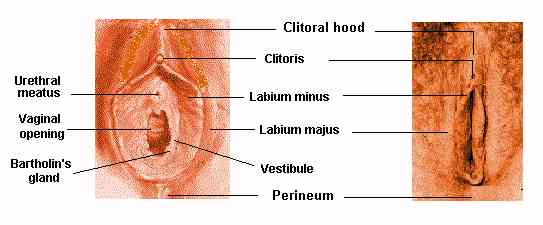
Fig.1. External genitals in female.
Massage, irritation, or other types of excitation of the
perinea region, of the sexual organs and of the urinary tract, generate
sexual sensations.
These sensations are taken to the spinal cord through the pudendal nerve and sacral plexus (fig.2). Besides, the local reflexes responsible at least for part of the feminine orgasm are integrated in the medulla sacra lumbar.
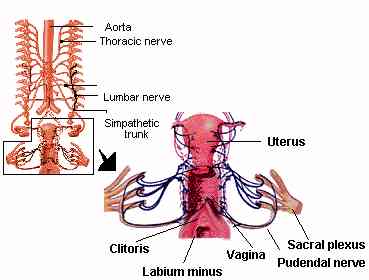 Fig.2. Innervation of female reproductive organs showing autonomic nerves containing sympathetic and parasympathetic efferent and afferent fibers In Blue: Parasympathetic fibers. In Red: Sympathetic fibers. |
The clitoris
is the main sex organ involved with the local excitation, receives,
responds to, and transmitts neural messages of the sexual stimulation.
It contains both afferent
(those that go to the spinal cord) and
efferent
(those that come from the spinal cord) neural pathways.
|
Near the vestibule (the entrance of the vagina) (fig.3),
and extending up to the clitoris, there exists an erectible tissue almost
identical to the erectible tissue of the penis. This tissue is controlled
by the parasympathetic nerves that pass through the erector nerves of the
sacral plexus to the external genitals.
it is assumed that androgens determines the reponsiveness to erotic stimuli,
that is, they cause growth of the clitoris (2).
In the absence of androgenic stimulation, arousability would be low, and
stimuli would not act to increase arousal.
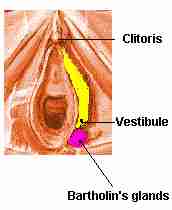 Fig.3. Female external genitalia |
The sympathetic impulses continue to the Bartholin's
glands (fig. 2) bilaterally
localized below the labium minus causing the secretion of mucus immediately
inside of the vestibulum. This mucus, together with great quantity of mucus
produced by the vaginal mucosity is responsible for the adequate lubrication
during the sexual intercourse.
Local sexual excitation goes to spinal cord through pudendal nerve and sacral plexus (fig.2). After penetrating the spinal cord, the impulses are transmitted to the brain. This lubrication, on the other hand, is necessary to promote a satisfactory and enjoyable sensation of massage during the intercourse, instead of a sensation of irritation that can be produced by a dry vagina. |

2 of 13
Go to the first page of this article
Author: Dr. Silvia Helena Cardoso, PhD. Psychobiologist, master and doctor in Sciences by the University of São Paulo and post doctoral fellowship by the University of California, Los Angeles. Invited Professor and Associate Researcher of the Center for Biomedical Informatics, State University of Campinas (Unicamp), Brazil.
Center for Biomedical Informatics
State University of Campinas, Brazil
Copyright 1997 State University of Campinas