
5 of 13
First Phase of Excitation
Excitement Phase
See the next excitation phase

|
Normal |
 |
 |
|
Excitement |
 |
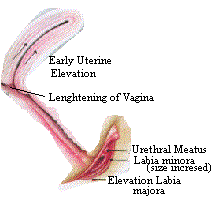 |
In the excitement, the body prepares for sexual activity by tensing muscles
and increasing heart rate and blood flows into the penis, causing it to
become erect; in the female, the vaginal walls become moist, the inner
part of the vagina becomes wider, and the clitoris enlarges.
|
Male |
Female |
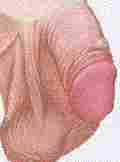
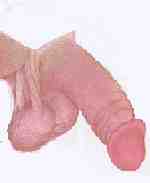
| Genital changes: Penile
erection results from massive vasocongestion, concentration of blood in
blood vessels in the three cavernous bodies that run the lenght of penis.
Arterial blood is collected in penis. Vasocongestion and tickening of the
scrotal skin are involved in the elevation of the scrotal sac.
Coital position has a role in determining which muscle groups will exhibit the miotonia (an increase in muscular tension) involving both voluntary and involuntary muscles during a particular sexual response cycle. Testicular lifting is accomplished through shortening of the spermatic cord by and involuntary contraction of the muscles near the cord. Increase in pulse and blood pressure, an increase in blood supply to the surface of the body resulting in increased skin temperature, flushing, rapid breathing, and a general increase in muscle tension. |
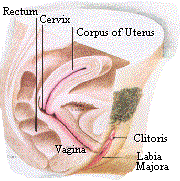
Genital changes: clitorial
glans (head), expansion and vaginal lubrication. The tumescence (swelling)
of the glans is a result of vasocongestion and always accompanies sexual
tensions. Vasocongestion is found in a number of different body parts, such as nipples, labia minora and the clitoris. Nipple erection and a slight increase of its size is a result of vasocongestion.
Increase in pulse and blood pressure, an increase in blood supply to the surface of the body resulting in increased skin temperature, flushing, and swelling of all distensible body parts, more rapid breathing, secretion of genital fluids, vaginal expansion, and a general increase in muscle tension. |
See next excitation phase
5 of 13
Go to the first page of this article
Author: Dr. Silvia Helena Cardoso, PhD. Psychobiologist, master and doctor in Sciences by the University of São Paulo and post doctoral fellowship by the University of California, Los Angeles. Invited Professor and Associate Researcher of the Center for Biomedical Informatics, State University of Campinas (Unicamp), Brazil.
Center for Biomedical Informatics
State University of Campinas, Brazil
Copyright 1997 State University of Campinas